
The Physics of Evaporation from Open Water Bodies
How open water evaporates: vapor-pressure deficit, the six driving factors, the boundary layer, why depth doesn't matter, and night-time loss.
By Editorial Team · Reviewed by Pending review ·
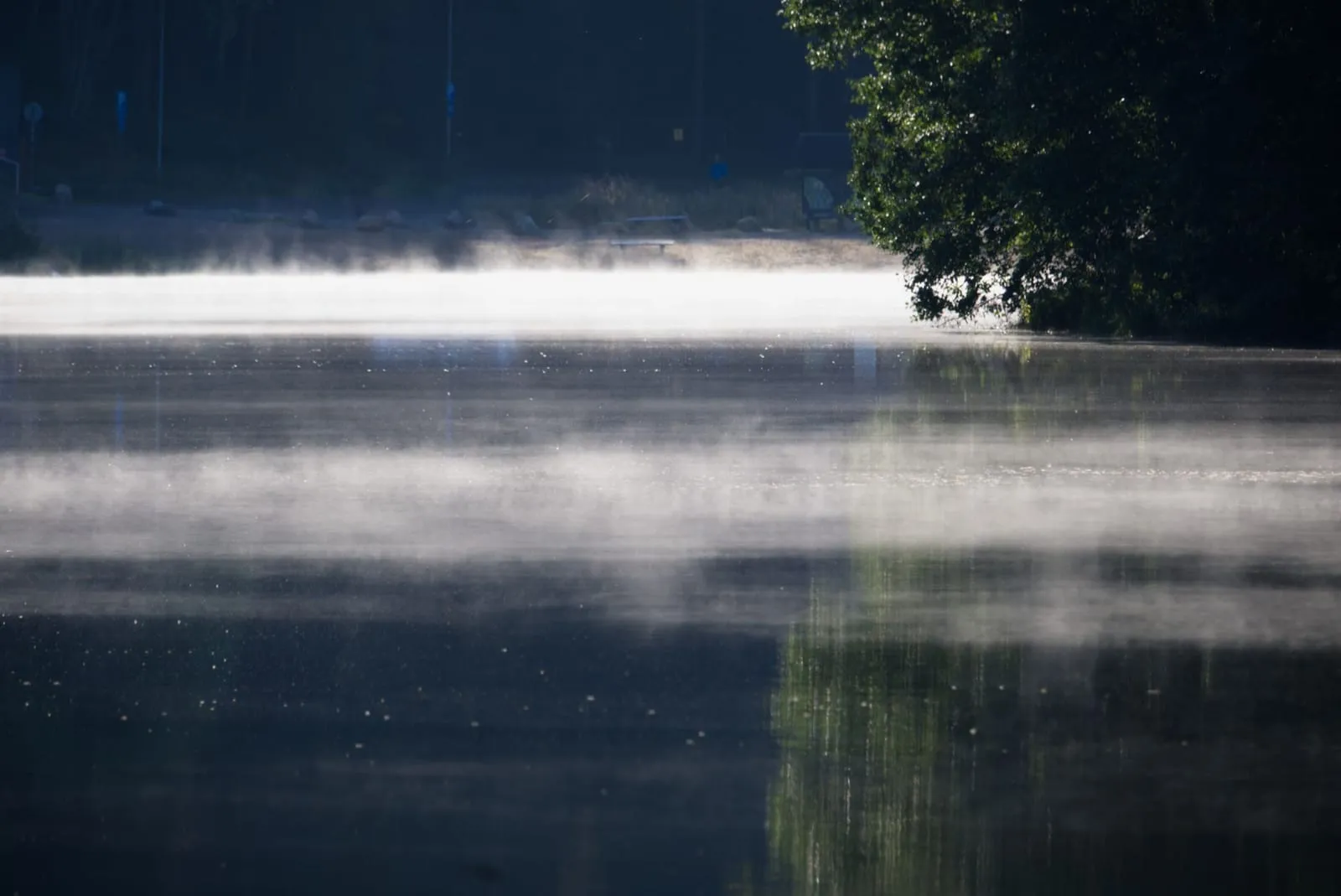
Evaporation looks simple from the bank of a reservoir, but the rate at which water disappears is governed by a tidy piece of physics. Understanding that physics is the foundation for everything else — measuring loss, calculating it, and reducing it. This article walks through the mechanism, the variables that matter, and two facts that consistently surprise people.
The engine: a vapor-pressure deficit
At the surface, water molecules are in constant motion, and a fraction always carry enough kinetic energy to break free into the air as vapor. The net rate at which this happens is set by the vapor-pressure deficit (VPD) — the gap between the saturation vapor pressure at the water surface and the actual vapor pressure of the air above it:
Here is the saturation vapor pressure at the water-surface temperature and is the actual vapor pressure of the air. When air is dry (low ) or water is warm (high ), the deficit is large and evaporation is fast. As air nears saturation, the deficit shrinks toward zero and net evaporation almost stops.
Saturation vapor pressure climbs steeply with temperature — a relationship well approximated by the Tetens equation:
Because the curve is exponential, a few degrees of surface warming raises disproportionately. That is the deeper reason warm climates lose water so quickly. (See our glossary entry on vapor-pressure deficit for a fuller definition.)
The boundary layer and why wind matters
Evaporation carries away latent heat, so the air immediately above the water cools and humidifies, forming a thin boundary layer of near-saturated air. Left undisturbed, this layer would suppress further loss, because the local deficit at the surface collapses.
Wind matters precisely because it sweeps that humid layer away and replaces it with drier air from upwind, keeping the deficit — and the loss — high. This is also why fetch (the unobstructed distance wind travels across the surface) affects the rate: longer fetch means more turbulent mixing and more exposure.
The six dominant factors
Six variables control how fast open water evaporates:
- Air temperature — warmer air can hold more moisture, allowing a larger deficit.
- Water-surface temperature — raises directly; warm surfaces evaporate fastest.
- Relative humidity — humid air narrows the deficit and slows loss.
- Wind speed (and fetch) — strips away the humid boundary layer.
- Surface area — sets how much water is exposed; total volume lost scales with it.
- Solar radiation — supplies the energy that warms the water and drives the phase change.
Two secondary factors fine-tune the result: atmospheric pressure / altitude (roughly +3% per 1,000 m as pressure falls) and salinity (high total dissolved solids lower the rate by about 5–15%).
Why depth does not change the rate — but area does
A persistent myth holds that deep water evaporates more slowly. It does not. Because evaporation is purely a surface process, the rate per unit area is effectively independent of depth. Depth changes only how long a body sustains the loss before it is drawn down.
Two ponds in the same climate lose the same depth-per-day; the deeper one simply lasts longer. The lever that actually changes total volume lost is surface area — which is exactly why nearly every engineered solution works by covering or shrinking the surface. We compare those approaches in methods to reduce evaporation.
Evaporation does not stop at night
Solar radiation is the biggest daytime driver, so it is tempting to assume loss halts after sunset. It does not. Water that absorbed heat all day stays warm into the night, keeping elevated, while the air often cools and dries. In arid climates, night-time evaporation can be roughly 25–40% of the 24-hour total — meaning any estimate that ignores it will run low.
From physics to numbers
The same VPD physics underlies every practical estimation method — pan, energy-budget, mass-transfer, and Penman-Monteith. Each packages temperature, humidity, wind, and radiation differently, but all are ultimately accounting for how fast the deficit can be supplied with energy and cleared by the wind. For the equations and how to choose among them, continue to how to calculate evaporation, or start with the plain-language overview in what is evaporation.