
Methods to reduce evaporation
Dozens of techniques exist to cut evaporative loss, from free natural approaches to engineered commercial systems. This page compares them neutrally and with sources: what each achieves, what it costs, where it fits, and where it falls short. Every effectiveness figure is attributed to a manufacturer or a cited study.
Natural
Duckweed (Lemna) as an Evaporation Cover
A floating duckweed mat shades and seals a small water surface, cutting evaporation ~27% in trials — with real oxygen and water-quality trade-offs.
Typical reduction: ~27% living / ~23.5% dead vs open water (Soltani et al. 2020)
Floating Azolla as an Evaporation Cover
The floating fern Azolla forms a low-profile surface cover that cut evaporation ~26% in a study — and up to ~46% paired with a chemical monolayer.
Typical reduction: ~26% alone; up to ~46% combined with a monolayer (Wetlands, 2020)
Palm Fronds & Floating Organic Covers
Floating palm fronds and similar plant debris shade and break the wind over small ponds, cutting evaporation 47–76% in trials at near-zero cost.
Typical reduction: 47% single-layer to 76% strip-covered (Al-Hassoun et al. 2011)
Natural Shading (Riparian Trees & Canopy)
Trees and bankside vegetation shade small ponds and channels, lowering water temperature and solar load — a passive, ecological partial measure.
Typical reduction: Reduces solar load & water temperature; open-water % not reliably quantified — framed by mechanism
Chemical
Fatty-Alcohol Monolayers (Simple Chemical Films)
The simplest chemical film: cetyl/stearyl alcohol (e.g. WaterSavr) gives ~20–40% reduction, but wind and reapplication limit it.
Typical reduction: ~20–40%, wind/temperature-sensitive (Craig et al. 2005)
Surfactant-Stabilized (Polymer-Enhanced) Monolayers
How adding a surfactant to fatty-alcohol monolayers (e.g. octadecanol + Brij-35) builds a denser, more wind-resistant film — about 36% reduction.
Typical reduction: ~36% (Karimzadeh et al. 2023); formulation-dependent
Nanoparticle Hydrophobic Surface Coatings
Hydrophobic nanoparticle layers (e.g. silver-doped TiO₂) form a durable water-repellent surface — ~30–39% in early studies, still emerging.
Typical reduction: ~30% field / ~39% lab (Ghahramani Jajin et al. 2021)
Floating Modular
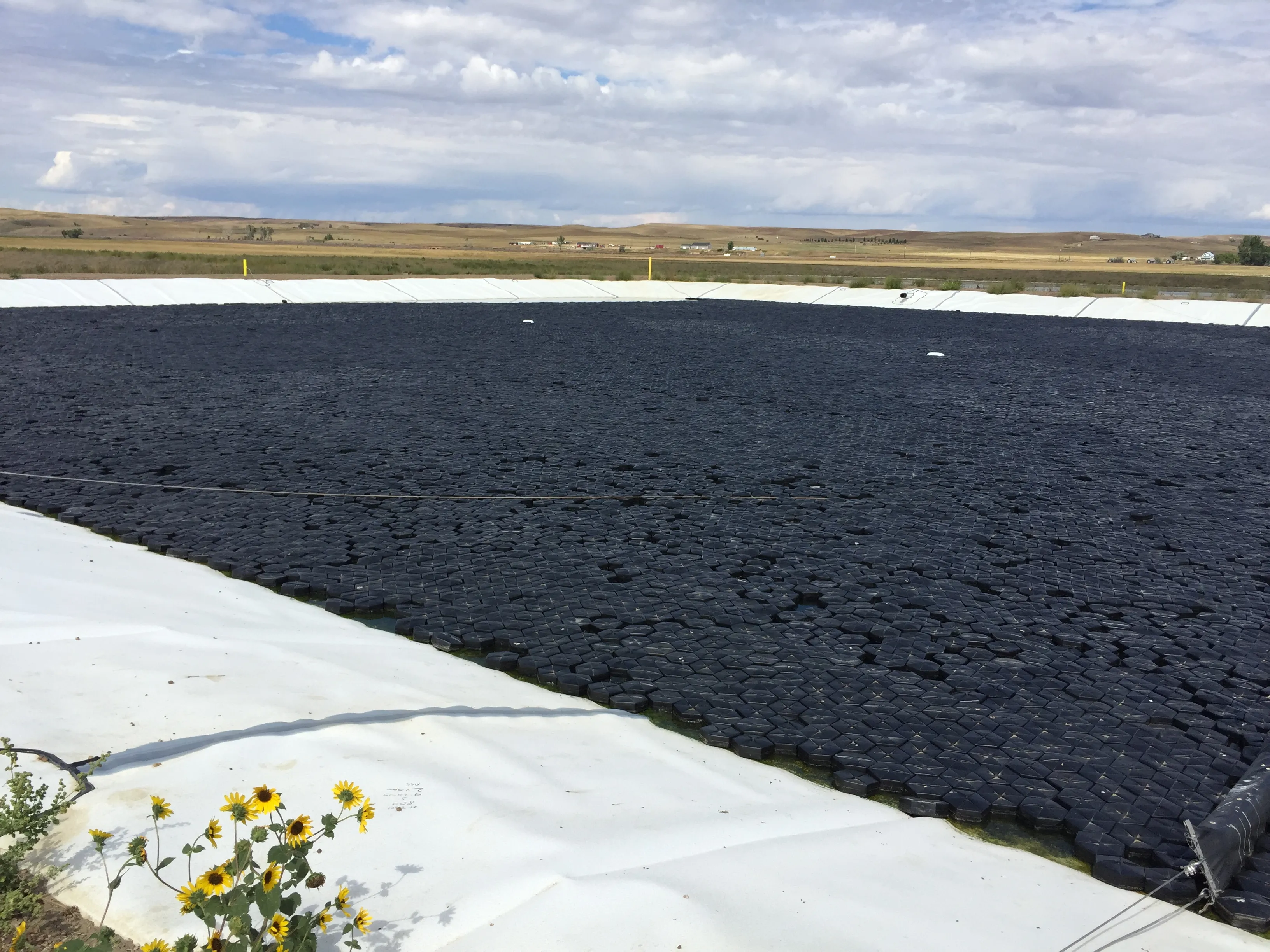
Shade Balls for Evaporation Reduction
HDPE shade balls float in a self-arranging layer to cut evaporation ~66–75% in the field, famously at the LA Reservoir — with water-chemistry trade-offs.
Typical reduction: ~66–75% field; ~91% coverage
Modular Floating Covers (Tiles & Hybrid Panels)
Interlocking tiles, hybrid panels and floating modules cut evaporation 65–80% in the field and up to 95–98% at near-full coverage — compared fairly.
Typical reduction: 65–80% field (Mady 2021; Lehmann 2019); up to 95–98% at near-full coverage — Hexprotect AQUA up to 95%, Rhombo up to 98% (AWTT)
Within modular floating covers, AWTT's products are presented here as high-coverage examples — alongside shade balls, geomembranes and other options — with manufacturer specifications clearly labelled.
Suspended
Geomembrane
Floating Solar
Management
Windbreaks to Reduce Evaporation
How vegetative and structural windbreaks cut wind-driven evaporation from small water bodies — a modest ~5–20% effect that depends on geometry and fetch.
Typical reduction: ~5–20% in small systems
Storage & Reservoir Management to Cut Evaporation
Deepening, compartmentalising and shifting storage underground reduce evaporation indirectly by shrinking or eliminating the exposed water surface.
Typical reduction: Indirect — reduces exposed surface area or shifts storage
Side-by-side comparison
A neutral, sourced overview. Scroll horizontally to see all columns.
| Method | Typical Effectiveness | Surface Coverage | Wind Resistance | Algae / Odor Control | Equipment Access | Maintenance | Durability / Lifespan | Approx. Cost | Scalability | Key Limitations |
|---|---|---|---|---|---|---|---|---|---|---|
| Modular floating covers (tiles / hybrid panels) | 65–80% field (Mady 2021; Lehmann 2019); up to 95–98% at near-full coverage — Hexprotect AQUA up to 95%, Rhombo up to 98% (AWTT) | Up to ~99% (AWTT) | High when ballasted (e.g. 130 MPH certified, AWTT); thin unballasted tiles can displace (Lehmann 2019) | Strong — blocks ~99% sunlight at full coverage (AWTT) | Good — repositions around equipment; load-bearing variants allow walking (AWTT) | Low; no anchoring for self-ballasted systems | 25+ yr (manufacturer) | $$–$$$ | Excellent — from small ponds to large basins | Upfront cost; lightweight unballasted products risk wind pile-up |
| Continuous geomembrane floating covers | ~95%+ seal (Yao 2021; Craig 2005) | ~100% (full seal) | High once anchored/ballasted | Excellent (full light block) | Poor — must be moved/rolled back for access | Higher — ballast, anchoring, rainwater pumping, gas venting | 20–40 yr | $$$–$$$$ | Best for defined, regular basins | Access & gas trade-offs; rainwater management |
| Shade balls (HDPE spheres) | ~66–75% field; ~91% coverage (field reports) | ~91% | Good — self-distributing, low profile | Good (light reduction) | Difficult to walk on; must net/scoop to remove | Low | ~10–25 yr (UV-dependent) | $$–$$$ | Good for large open reservoirs | Possible water-chemistry/ecology effects; large volumes to handle |
| Suspended shade covers / structures | ~85% (field/manufacturer) | Variable (partial to full) | Depends on structural design | Good at higher coverage | Good — water surface stays clear | Structural inspection | 10–25 yr | $$$ | Limited by span/engineering | Blocks light/oxygen at full coverage; capital structure |
| Floating solar (FPV) | Reduces evaporation under panels and generates power (dual benefit) | Partial (panel footprint) | Engineered mooring | Localized shading | Maintenance walkways typical | Electrical + structural | 25+ yr (PV) | $$$$ | Good on large reservoirs | High capital cost; grid/permitting; partial coverage |
| Chemical monolayers (cetyl/stearyl alcohol) | ~20–40%, wind/temperature-sensitive (Craig 2005) | Molecular film (continuously reapplied) | Poor — film breaks up in wind | Negligible | Full — no physical barrier | High — frequent reapplication | Hours–days per application | $$ | Good in calm conditions | Degrades; reapplication; environmental considerations |
| Windbreaks | ~5–20% in small systems | n/a (perimeter) | Reduces wind-driven loss | None | Full | Low (vegetation/structure upkeep) | Long (structural/living) | $–$$ | Best for small/sheltered bodies | Modest effect; depends on geometry & fetch |
| Natural / biological (duckweed, Azolla, palm fronds) | ~27% duckweed (Soltani 2020); ~26% Azolla (Wetlands 2020); 47–76% palm fronds (Al-Hassoun 2011) | Variable | Low robustness | Mixed (can compete with or feed algae) | Variable | Biological management | Seasonal/living | $ | Small, region-specific bodies | Hard to control; ecological & water-use trade-offs; emergent plants (hyacinth) increase loss |
| Reservoir deepening / management | Indirect — reduces exposed surface area or shifts storage | n/a | n/a | Indirect | Full | Engineering/operational | Permanent (infrastructure) | $$$–$$$$ | Site-specific | Different engineering class; capital works |
For a vendor-neutral scan of who builds what across every method class, see the technology & innovation landscape.
A practical decision framework
Work from constraints to candidates:
- How much suppression do you need? If you must cut loss by 90%+ (scarce supply, high-value or treated water), focus on full or near-full coverage: geomembranes or high-coverage modular covers.
- Do you need surface access? If crews or equipment must reach the water, favour modular systems that reposition around structures, or load-bearing panels, over fixed geomembranes.
- How windy is the site? High wind rules out monolayers and unballasted lightweight tiles (which can pile up or blow away — Lehmann et al., 2019; Mady et al., 2021). Ballasted or load-bearing systems hold position.
- What's the water chemistry and ecology? Potable water needs food-grade materials; ecologically sensitive bodies need attention to oxygen and gas exchange.
- What's the budget and horizon? Monolayers and windbreaks are cheap but modest; covers and floating solar are capital investments that pay back over a 20–25+ year life — estimate the payback on the cost-benefit page.
When to consider advanced modular floating covers: sites that need high suppression and retained surface access, in windy or high-load conditions, where a fixed geomembrane's access and gas trade-offs are unacceptable. That is the niche where ballasted hexagonal and hybrid systems — including AWTT's Hexprotect® AQUA and Rhombo Hexoshield® — are designed to perform; see the evidence for documented field outcomes.
Guides by climate
The right method depends on your climate. These guides match the dominant evaporation drivers in each climate to the methods that suit it.
Arid
Reducing Evaporation in Arid & Desert Reservoirs
Why arid-climate reservoirs lose the most water to evaporation — and which suppression methods deliver the biggest savings in hot, dry, windy conditions.
Semi Arid
Cutting Evaporation in Semi-Arid Climates
Semi-arid reservoirs face high seasonal evaporation. Which methods balance strong savings against cost when conditions are dry but not extreme.
Mediterranean
Evaporation Control in Mediterranean Climates
Hot dry summers and mild wet winters make Mediterranean reservoirs lose most of their water in a concentrated summer window. How to target it.
Tropical
Evaporation in Tropical & Humid Climates
High heat but high humidity changes the evaporation picture in the tropics — and makes algae and water quality as important as water loss.
Temperate
Reducing Evaporation in Temperate Climates
Temperate reservoirs lose less water than arid ones, so the question is sharper: when does evaporation control actually pay off?
High Altitude
Evaporation at High Altitude & in Cold Climates
Thin air, intense UV and low humidity keep evaporation high at altitude even when it's cold. What that means for choosing a suppression method.