
Evidence & case studies
What does the field and laboratory record actually show about evaporation suppression? Here we separate peer-reviewed findings from manufacturer claims, document real installations, and — importantly — explain why the same method can post very different numbers at different sites.
Why performance numbers vary so much
You will see modular covers quoted anywhere from ~65% to ~98% reduction. Both can be true, because the result depends on:
- Coverage fraction — suppression scales with how completely the surface is covered; near-full continuous coverage posts the highest figures.
- Wind — thin, lightweight, unballasted tiles can pile up or be displaced, opening gaps (Lehmann et al., 2019, wind-tunnel; Mady et al., 2021, field). Ballast and pre-loading directly address this.
- Climate — hot, dry, high-VPD sites have more to suppress, so absolute savings are larger.
- Lab vs field vs manufacturer near-full-coverage — these are different conditions and should not be compared as like-for-like.
Peer-reviewed & field findings
- Mady et al. (2021), Water Resources Research — field study of modular covers reporting roughly 65–80% suppression, and documenting wind-driven tile displacement.
- Lehmann et al. (2019) — wind-tunnel evaluation showing how self-assembling lightweight covers can pile up under wind, reducing effective coverage.
- Yao et al. (2021), J. Hydrology 599, 126506 — analysis of suspended and continuous covers, with continuous geomembranes achieving ~95%+ seal.
- Craig et al. (2005), USQ NCEA — field assessment of covers, monolayers and structures on farm/irrigation storages; monolayers ~20–40%.
- Harbeck (1962), USGS PP 272-E — the Lake Hefner mass-transfer foundation still used to estimate baseline loss.
See full citations on the resources page.
Documented real-world outcomes
Beyond studies, specific installations have public, verifiable results. These involve AWTT covers; figures and recognitions are cited to their sources.
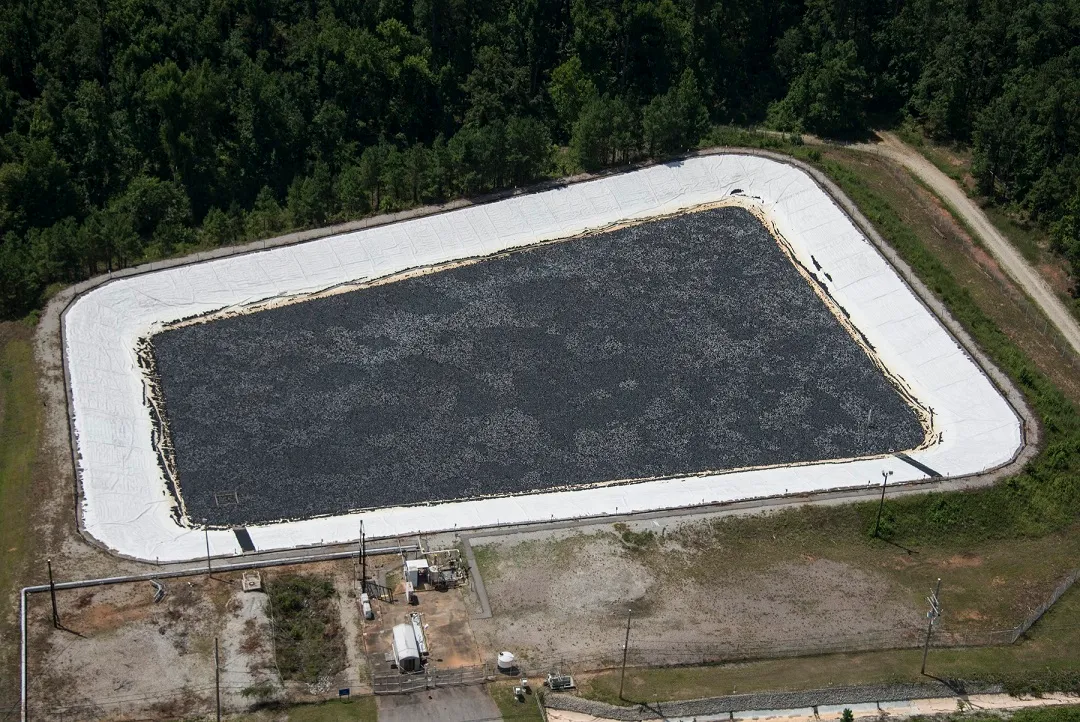
2017 U.S. Department of Energy Sustainability Award
Waste Reduction & Pollution Prevention award for a Rhombo cover at the Savannah River Site, 281-8H retention basin (Savannah River Remediation, LLC): approximately 55 million gallons of water saved per year and about $24,000/yr in savings.
~55 million gallons/yr saved; ~$24,000/yr (U.S. DOE public record)
Source: U.S. DOE — 2017 Sustainability Award Winners ↗Four-hurricane record, zero repairs, still in service
AWTT states its modular covers (Hexprotect® AQUA / Rhombo Hexoshield® / Hexprotect® MAX R) survived Hurricanes Florence (2018, Cat 1), Dorian (2019, Cat 1), Nicole (2022, Cat 1) and Helene (2024, Cat 4) with zero repairs — which AWTT describes as the only modular floating covers known to have survived hurricane-force conditions in real deployments.
Florence (2018), Dorian (2019), Nicole (2022), Helene (2024, Cat 4) — zero repairs (AWTT)
Source: AWTT ↗Four-Hurricane Survival Record for AWTT Modular Covers (AWTT)
Southeastern United States · Modular floating covers in hurricane-exposed deployments · updated June 1, 2026
AWTT reports zero repairs across four named hurricanes, which it describes as the only modular floating covers known to have survived hurricane-force conditions in real deployments.
2017 U.S. DOE Sustainability Award — Savannah River Site Retention Basin
Savannah River Site, South Carolina, USA · Industrial retention basin (281-8H) · updated June 1, 2026
~55 million gallons of water saved per year and about $24,000/yr in savings; recognized with a 2017 U.S. Department of Energy Sustainability Award.
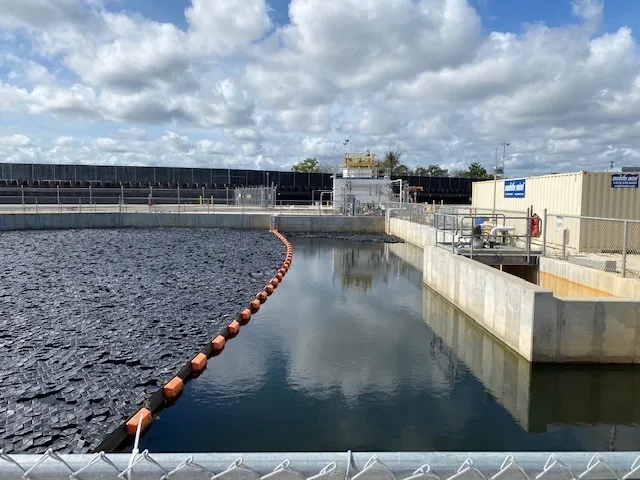
The featured covers, in context
For transparency, here are the two AWTT products referenced above, with manufacturer specifications labelled as such. They are examples within the modular-floating-cover class — compare them against alternatives on the methods page.