
What is evaporation?
Evaporation is the process by which liquid water becomes vapour and leaves an open surface for the air above it. For reservoirs, ponds, lakes and industrial basins it is the single largest natural loss pathway — and, unlike a leak, it happens everywhere the water meets the sky.
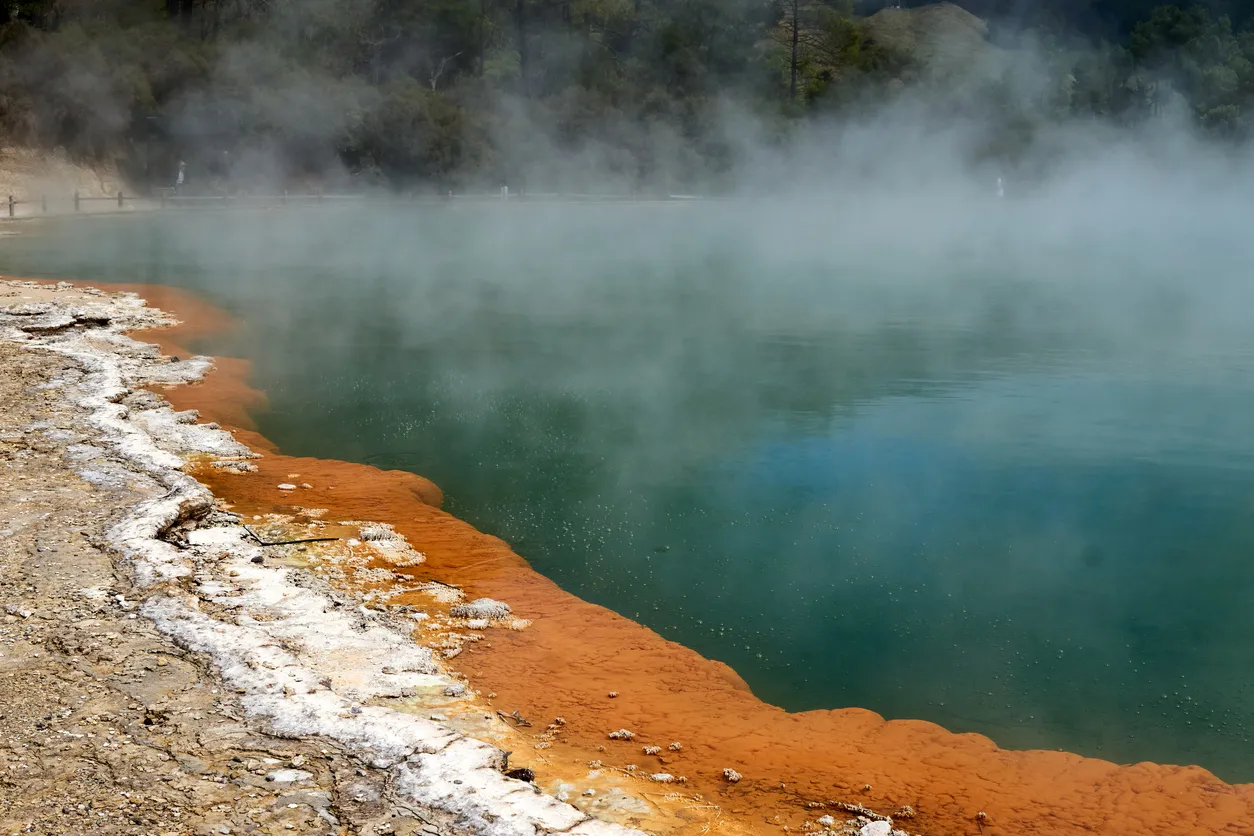
The physics: a vapour-pressure deficit
Water molecules at the surface are in constant motion. A fraction always have enough kinetic energy to break free of the liquid and enter the air as vapour. The net rate at which this happens is governed by the vapour-pressure deficit (VPD) — the gap between the saturation vapour pressure at the water surface and the actual vapour pressure of the air above it:
where is the saturation vapour pressure at the water-surface temperature and is the actual vapour pressure of the air. When the air is dry (low ) or the water is warm (high ), the deficit is large and evaporation is fast. When the air approaches saturation, the deficit shrinks toward zero and net evaporation nearly stops. Saturation vapour pressure rises steeply with temperature, which is well approximated by the Tetens relation:
Evaporation cools the surface (it carries away latent heat), which is why a thin boundary layer of cooler, more humid air forms just above the water. Wind matters precisely because it sweeps this saturated boundary layer away and replaces it with drier air, keeping the deficit — and the loss — high.
The six factors that drive the rate
Six variables dominate how quickly open water evaporates:
- Air temperature — warmer air holds more moisture, allowing a larger deficit.
- Water-surface temperature — raises directly; warm surfaces evaporate fastest.
- Relative humidity — humid air narrows the deficit and slows loss.
- Wind speed (and fetch) — removes the humid boundary layer; longer fetch increases exposure.
- Surface area — sets how much water is exposed; total loss scales with it.
- Solar radiation — supplies the energy that warms the water and powers the phase change.
Two secondary factors adjust the result: atmospheric pressure / altitude (roughly +3% per 1,000 m as pressure drops) and salinity (high total dissolved solids lower the rate by about 5–15%).
Why depth doesn't change the rate — but area does
A common misconception is that deep water evaporates more slowly. It does not. Because evaporation happens only at the surface, the rate per unit area is effectively independent of depth. Depth changes only how long a body can sustain the loss before it is drawn down. Two ponds in the same climate lose water at the same depth-per-day; the deeper one simply lasts longer. The lever that actually changes total volume lost is surface area — which is exactly why nearly every engineered solution works by covering or shrinking the surface.
Evaporation continues at night
Solar radiation is the biggest daytime driver, so it is tempting to assume evaporation stops after sunset. It doesn't. Water that absorbed heat during the day stays warm into the night, keeping elevated while the air often cools and dries. In arid climates, night-time evaporation can account for roughly 25–40% of the 24-hour total. Any estimate that ignores night-time loss will run low.
Evaporation, transpiration, and ET
It is worth keeping three terms distinct:
- Evaporation — water leaving an open surface (our focus).
- Transpiration — water released by plants through their leaves.
- Evapotranspiration (ET) — the combined total from a vegetated surface.
This distinction has a practical consequence: the famous Penman-Monteith equation was designed to estimate ET from vegetated land. Applied directly to open water it tends to over-predict, so it must be adapted (open-water albedo and resistance terms) before it is reliable for a reservoir. We cover the adapted methods in how to calculate evaporation.
How evaporation is measured
Two field approaches dominate:
- Evaporation pans (e.g. the US Class A pan) measure water lost from a standardised open pan; a pan coefficient (~0.7) converts the reading to lake-equivalent loss. Simple and widespread, but pans heat and cool faster than a large water body.
- Eddy covariance and energy-budget methods use micro-meteorological instruments to measure the vapour flux or close the surface energy balance directly. More accurate, more expensive.
Why it matters: drought, cost and climate
Evaporative loss is water that was already captured, conveyed and often treated — so losing it is expensive twice over. In drought-prone regions it can rival or exceed the volume delivered to users, accelerating water scarcity, concentrating salts and nutrients (feeding algae), and raising the effective cost of every delivered litre. A warming climate widens the vapour-pressure deficit, which is expected to increase open-water evaporation over time — making suppression methods more valuable, not less.
Frequently asked questions
Does deeper water evaporate more slowly?
Does evaporation stop at night?
What is the difference between evaporation and evapotranspiration?
How much can salinity or altitude change the rate?
Next
Calculate evaporation
The equations and methods, explained.
Solutions
Reduce evaporation
Every method, compared fairly.
Reference
Glossary
Key terms defined.